
Problem
Many churchgoers want to tithe and donate faithfully but struggle with inconvenient methods (cash, cheques, multiple platforms), lack of transparency (where funds go), and forgetfulness (missing recurring gifts). Churches, in turn, face inconsistent donations and administrative burdens from manual tracking.
How might we design a mobile app that simplifies recurring donations while fostering trust and ease of use?
Solution
Blessings, a church tithing mobile app that simplifies tithing and donations with one-tap giving, recurring donations, and transparency features—so users give joyfully and see their blessings in action.
We believe giving should be a joyful act of worship, not a chore. Blessings removes the friction from faithful generosity so churches can focus on their mission and donors can experience the happiness of giving.
Research and Findings
To understand the landscape of tithing in churches, I wanted to first explore the challenges, emotions, behaviours, and pain points that churchgoers might face when tithing. These insights will guide the development of key features and validate any design assumptions.
Secondary Research
Beginning with data analysis and research articles, I explored the rationale behind the struggle of consistent tithing in the modern church landscape.
Based on the secondary research conducted, I identified the following key themes and insights that would validate some of my design assumptions.
Church Loyalty
77% of donations come from just 10-20% of churchgoers. (Nonprofits Source)
Digital Shift
60% of church donations are now made digitally. (Nonprofits Source)
Recurring Habits
Recurring giving increases donor retention by 42%. (Nonprofits Source)
Barriers to Consistent Tithing
Research shows that churchgoers struggle with consistent tithing due to three key friction points: forgetfulness, distrust in digital platforms, and inconvenient processes.
From a UX lens, outdated church apps often exacerbate these issues—requiring multi-step logins, lacking recurring payment defaults, or failing to communicate fund transparency. Additionally, cash-dependent users (especially older demographics) resist mobile solutions without clear onboarding.
32%
intend to give but don’t carry cash or remember.
25%
feel concerns about security and transparency tithing digitally.
25%
feel concerns about security and transparency tithing digitally.

Every Sunday, I tell myself that I will remember to get cash. But I always end up forgetting while between getting ready and rushing out the door.

How do I know my money actually helps my church? If I knew where exactly my money went, I’d give more joyfully. Right now, I just hope it’s used well.

I've been tithing with cash for years now. I know the church says it’s safe to tithe digitally, but it’s hard to trust something I can’t hold in my hands.
Primary Research
Using a mixed-method interactive testing format via Google Meet and in-person, I conducted non-traditional user interviews with 6 participants from churches within the Greater Toronto Area. Each 30-minute session included a series of open-ended questions to gather insights and user feedback that would help dictate the direction of the design. From these interviews, we were able to identify obstacles that hindered their ability to tithe freely and consistently.
The Cash Reliance Dilemna
Many churchgoers, especially those balancing work, family, and personal responsibilities, struggle to remember cash or cheques on Sundays. Research shows that 68% of traditional givers miss at least 1–2 tithes per month simply due to forgetfulness. For these users, giving is a spiritual commitment, but the friction of physical methods leads to guilt and inconsistency. To solve this, I designed a one-tap donation flow with recurring options, allowing users to automate their tithes. The app defaults to their home church and suggests preset amounts, reducing decision fatigue.
The Transparency Gap
A major hurdle for donors is uncertainty about how their contributions are used. Without clear visibility, users hesitate to give more or designate funds, fearing their money might disappear into administrative overhead. Over 80% of donors say they’d give more if they saw tangible outcomes. To build trust, I introduced real-time impact tracking for urgent causes, showing the collaborative efforts of others in reaching the donation goal. Each fund type includes a brief description explaining its purpose, reinforcing stewardship. This transparency transforms giving from a blind act of faith into a meaningful connection with their church’s mission.
The Digital Hesitation
Through our research, I identified that older congregants, who often prefer traditional giving methods, resist digital tithing due to security concerns, fear of errors, or a sense that apps lack the reverence of physical offerings. Only 29% of this demographic currently use giving apps. To ease the transition, I incorporated familiar metaphors and biometrics to minimize any unnecessary complications. By designing with accessibility guidelines in mind, I ensure that the design is as functional as it is aesthetic. Framing the app as a tool for easier faithfulness—not just convenience—helps bridge the gap between tradition and technology.
User Persona

Tiffany Day
Creative Director & Design Mentor
“I love supporting my church, but being constantly on the road with work, I need giving to fit my life. If I could do it all from my phone—and actually see the difference—I’d give more joyfully."
Pain Points
Forgets to bring cash/cheques on Sunday’s.
Unable to attend in-person services consistently.
Unsure how tithings are allocated.
Difficulty keeping track of tithings.
Goals
Simple, fast, and secure giving.
Knowing where funds are allocated.
Build a consistent tithing routine.
Share tithing activity with others.
Behaviours
Exclusively uses mobile apps due to job nature.
Likely to tithe more during church holidays or in person.
Prefers recurring tithing to avoid forgetting.
Enjoys talking about her contributions to friends and family.
User Task Flow
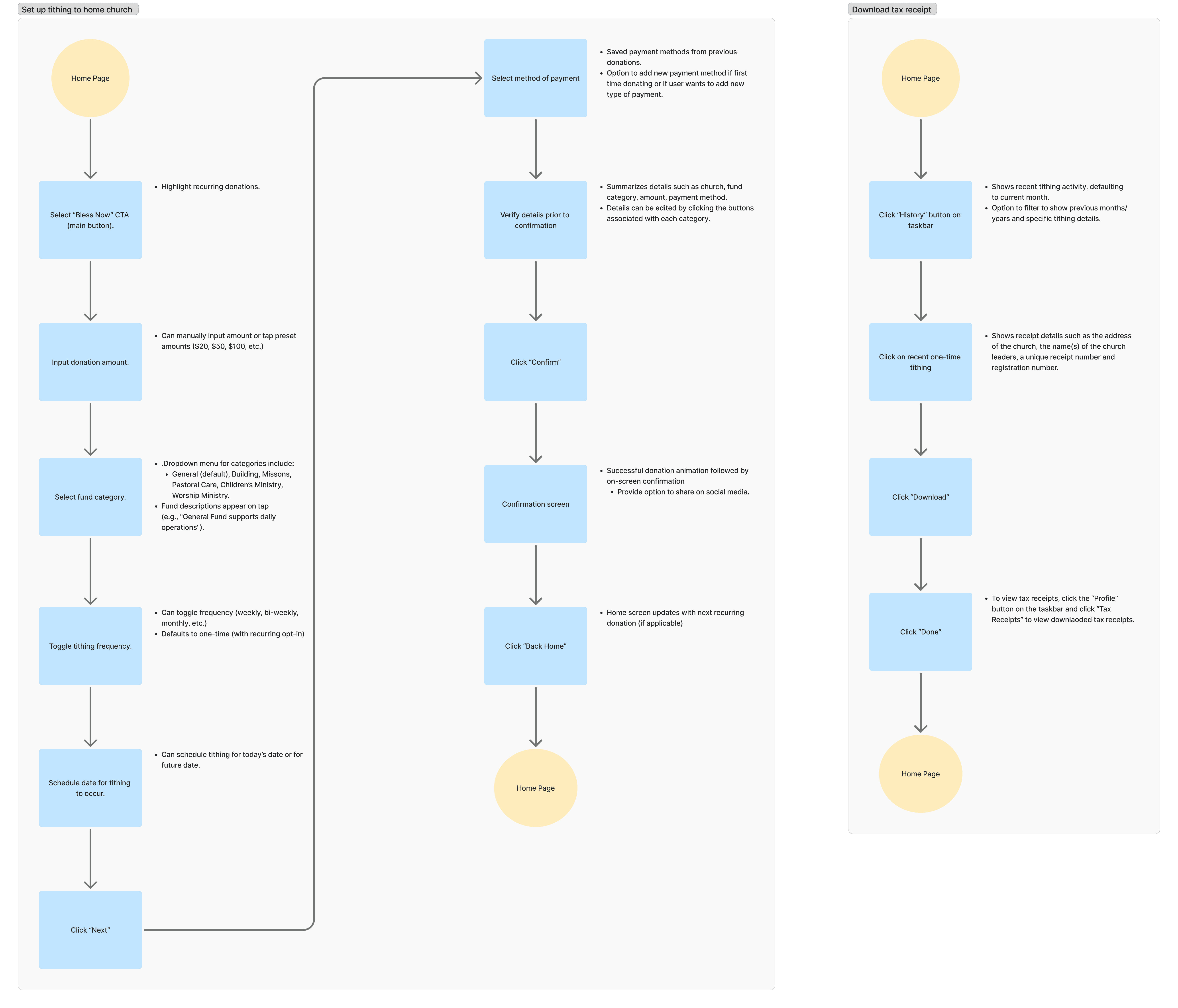
This user task flow outlines two primary high-intent pathways: the core Donation/Tithing Conversion Funnel and the Post-Transaction Tax Receipt Retrieval.
As a UX Designer, I see a flow that prioritizes transparency and user agency, moving from a centralized "Home Page" into linear, step-by-step processes that minimize cognitive load.
Wireframing
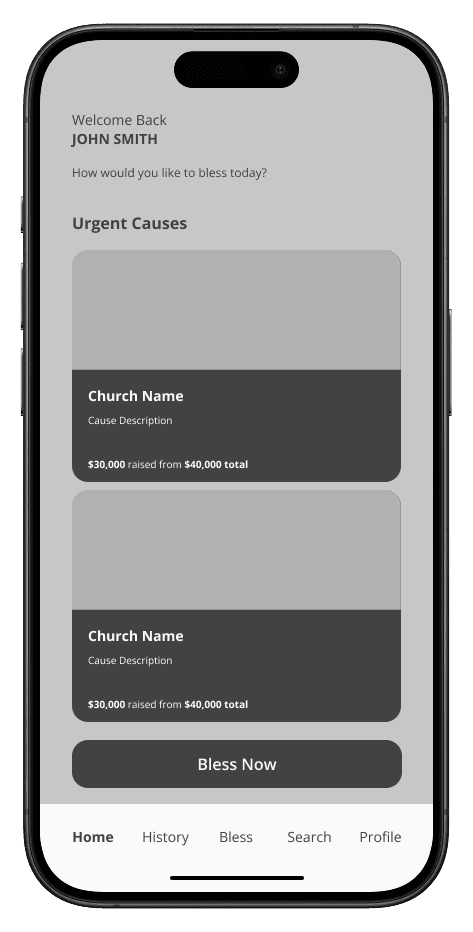
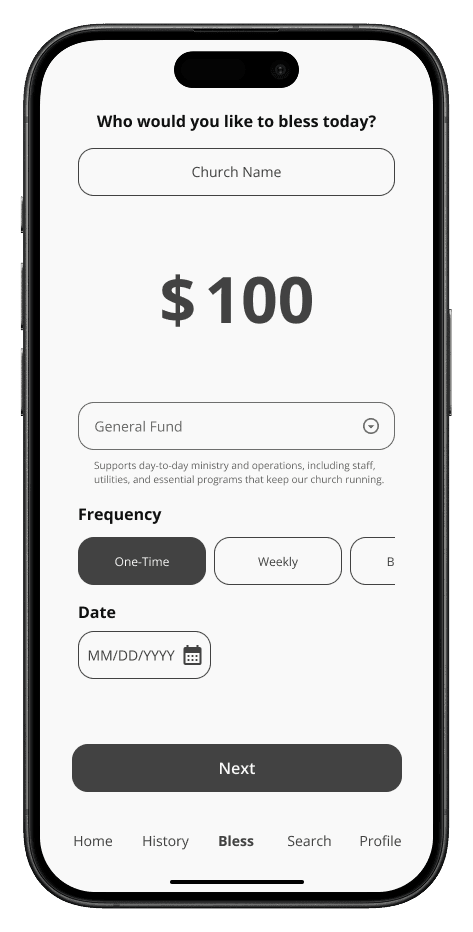
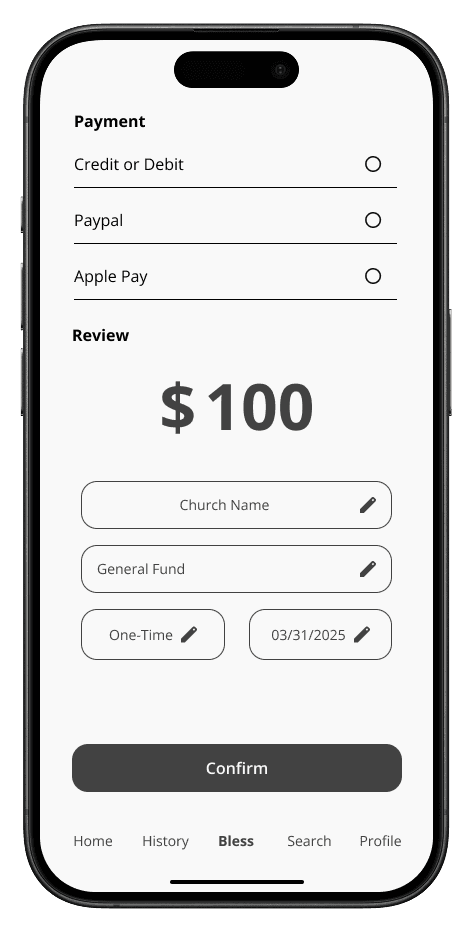
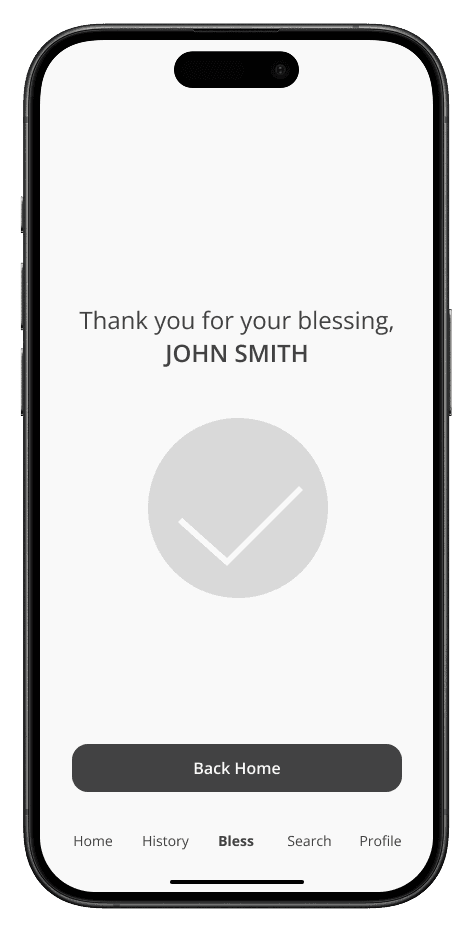
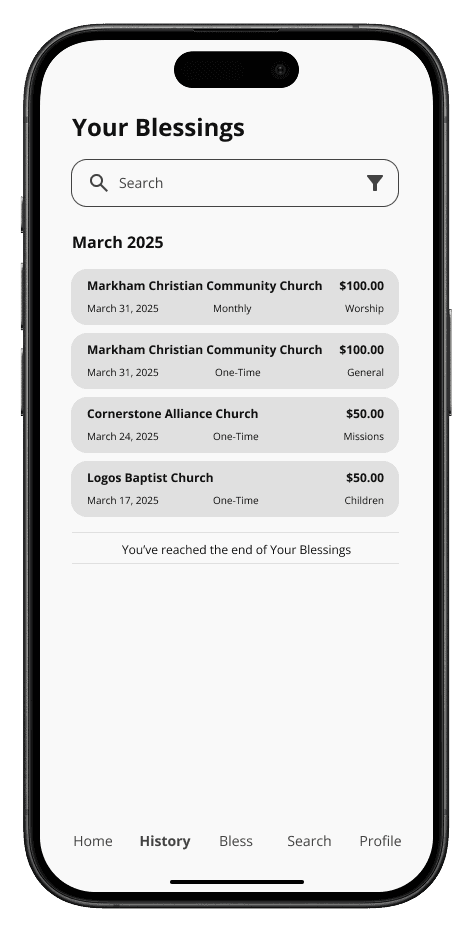
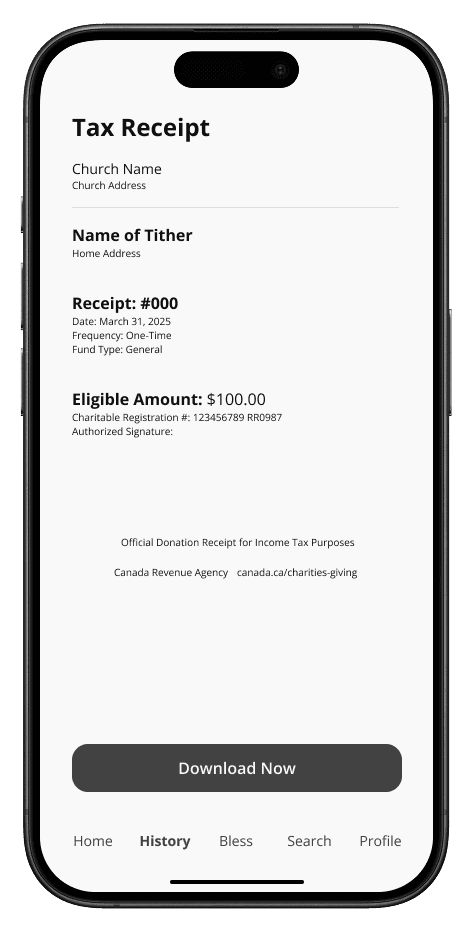
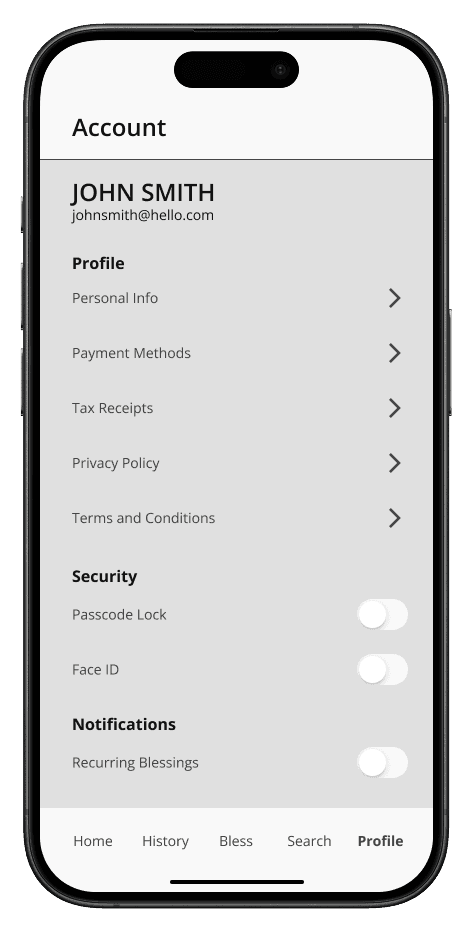
By centering the design on Convenience, Transparency, and Consistency, I transformed the traditional tithing experience from a rigid financial transaction into a meaningful community touchpoint. My process utilized emotive UX writing and strategic friction to ensure every "Blessing" felt intentional, while progressive disclosure and value-added Utility—like instant tax receipts and automated giving.
This User-Centered approach balances a minimalist, low-friction interface with high-trust features like real-time cause tracking and biometric security, creating a digital ecosystem that simplifies the logistics of faith without losing its heart.
Iterations
The first round of usability testing was conducted on low-fidelity wireframes to validate core user flows before investing in high-fidelity design and development. This lean approach allowed for rapid iteration based on early feedback, ensuring foundational usability issues were addressed before visual polish was applied.
Some key thoughts that I had in mind while conducting the initial round of usability testing:
Focus on Functionality Over Aesthetics
By stripping away colours, images, and detailed UI elements, users concentrated on task completion rather than subjective visual preferences.
Identify Structural Flaws Early
Testing at this stage exposed navigation gaps that would have been costly to fix post-development.
Encourage Honest Feedback
Participants were more likely to critique rough wireframes, whereas high-fidelity designs often elicit polite but less actionable responses.
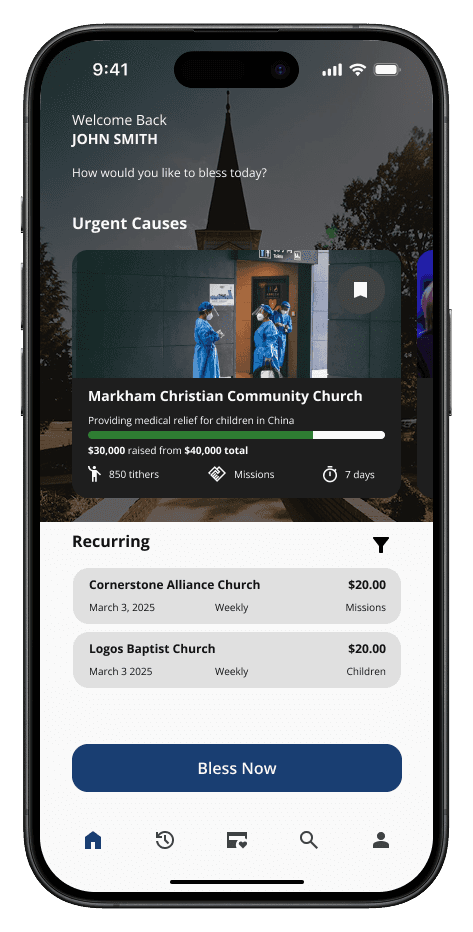
I prioritized Visual Impact and Transparency by evolving static cause descriptions into a dynamic engagement feed. By integrating progress visualization and time-sensitive indicators, I addressed the user's need for direct impact metrics, transforming the interface into a source of immediate visual feedback.
I also strategically introduced a recurring module to shift the user journey from a transactional mindset to a habitual one. This design choice leverages Recognition over Recall, ensuring existing commitments remain top-of-mind while reducing the cognitive load associated with managing ongoing donations.
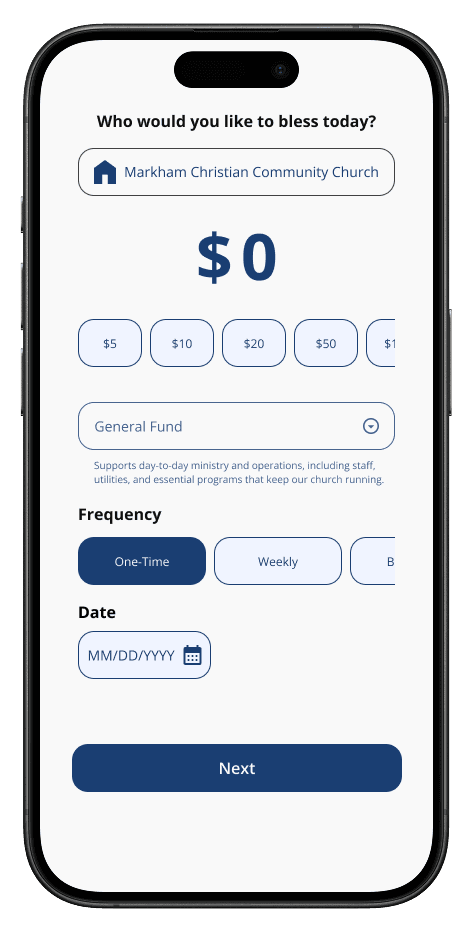
I wanted to optimize the task completion via smart defaults. To do that, I introduced "Preset Amount Chips" to streamline the donation process. By analyzing common tithing behaviors, I moved from a manual input-only field to a hybrid model that offers the most frequent gift amounts as "one-tap" options. This design choice reduces interaction cost and cognitive load, allowing users to bypass the keyboard and reach the checkout phase faster. It satisfies the user's desire for a "smarter way" to donate by significantly shortening the task completion time.
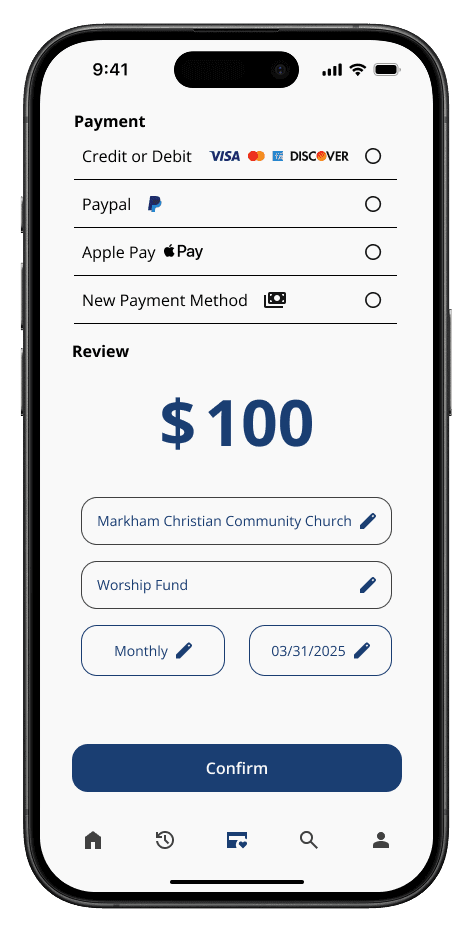
The evolution of the "Payment & Review" screen focuses on User Autonomy and Flexibility. Recognizing that users have diverse financial habits, I expanded the payment section beyond a static list to include a "New Payment Method" CTA (Call to Action). By integrating secondary visual cues—like credit card and digital wallet icons—I leveraged Affordance to make the options more recognizable at a glance. This iteration ensures the app allows for input flexibility, catering to user preference for multiple, easily manageable funding sources.
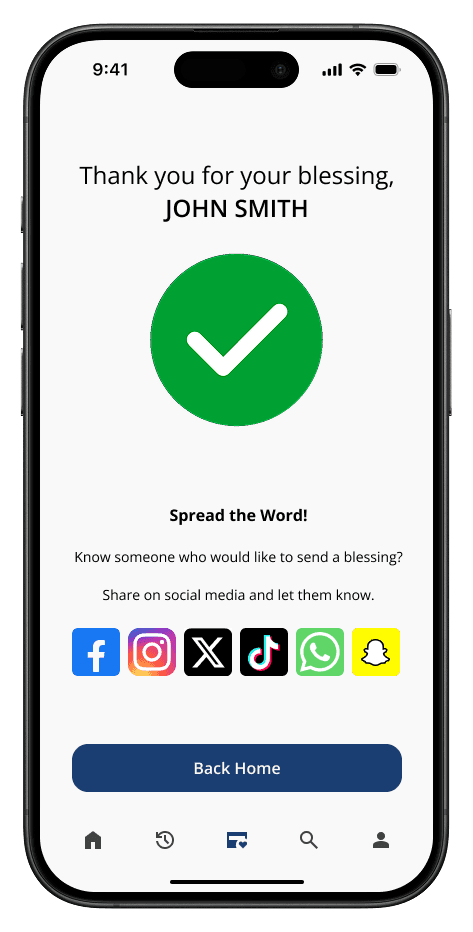
To address the disengaging nature of a standard confirmation screen, I transformed the success state into a tool for social proof and community building. By adding a "Spread the Word" module with social sharing integration, I shifted the final step of the user journey from a private receipt to a public invitation. This methodology taps into the concept of Gamification and Social Belonging, encouraging users to share their commitment and build a collective sense of mission. It effectively closes the loop of the user journey by reinforcing the emotional reward of giving.
Usability Testing
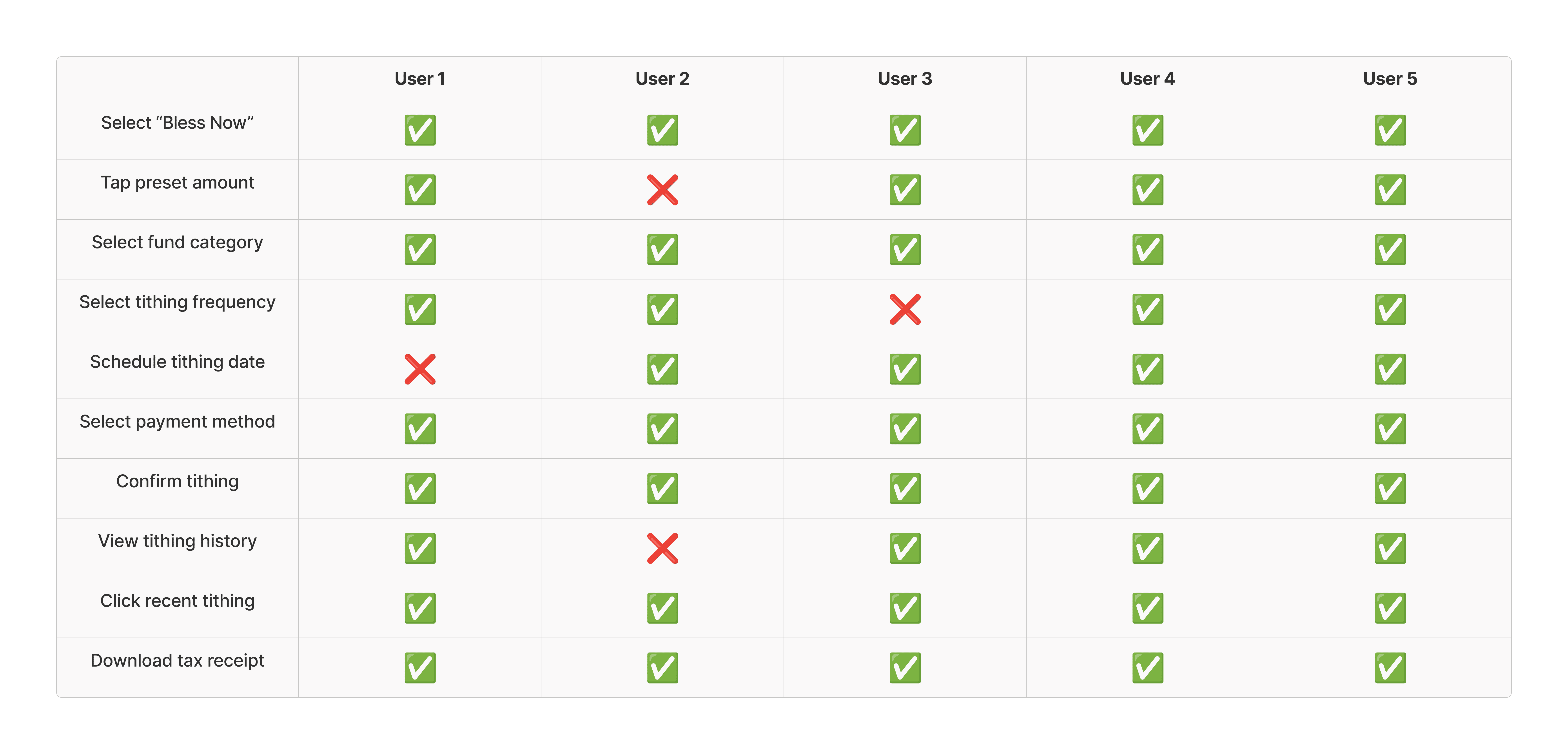
The formal round of testing resulted in a 92% average task completion rate.
The data is extracted from the final round of user testing with the high fidelity prototype. Some usability changes were made after the issues were proposed.
Reflections
Designing for Faith: Balancing Functionality with Emotional Resonance
Designing for a faith-based community requires a delicate equilibrium between technical efficiency and spiritual intention. My process revealed that a successful tithing app must do more than just process payments; it must transform a perceived obligation into an act of joy.
By focusing on Habit-Aware Design and Accessibility, I aimed to lower the barrier to entry for those wanting to build a good tithing habit. This taught me that when functionality is infused with emotional resonance, the digital interface becomes a bridge for faithfulness rather than just a financial utility.
Transparency as the Foundation of User Trust
Through this project, I realized that true user confidence is built through Visibility, not just security badges. While encryption and authentication are mechanical necessities, users respond far more powerfully to seeing the direct impact of their generosity.
By integrating descriptive fund categories and real-time progress indicators, I addressed a core user pain point: the "Void" of traditional giving. Providing this level of Information Transparency proved to be the most effective way to solidify user comfort, proving that a clear "why" is just as important as a secure "how."
Friction as a Feature, Not a Bug
Generally, the goal for users is task completion through "one-click" speed. However, I discovered that in a religious context, moving too fast can make a meaningful gift feel like a mindless bill payment. By intentionally including a Review & Confirm step—what I call "strategic friction"—I allowed users a final moment of reflection and certainty.
This taught me that UX isn't always about the fastest path to completion; it’s about the quality of the experience. Designing a moment of "peace of mind" proved more valuable than shaving off two seconds of task time, ensuring the digital act felt as intentional as a physical one.